
Customer Spotlight: Cruz Azul’s Rodrigo Yavarone
Blinkfire is proud to work with some of the biggest and best sports, media, and entertainment organizations in the word and connect with smart and innovative people on a daily basis. The work and creativity our customers do deserves to be showcased, which we highlight in our Customer Spotlight Series. In this addition, we’re excited to welcome Rodrigo Yavarone, Business & Communications Manager at Cruz Azul.
Rodrigo Yavarone leads the commercial, image, and communication areas at CF Cruz Azul. He is an Economist with a Master’s in Sports Management and another in Sports Marketing. Rodrigo has more than 10 years of experience in the sports entertainment sector, primarily in football, including key roles at Valencia CF, World Padel Tour, and Club Nacional de Football in Uruguay.
Cruz Azul is a Liga MX club based in Mexico City. It is one of the most successful teams in the country, boasting 24 titles, including 9 league championships and 6 CONCACAF Champions League trophies.
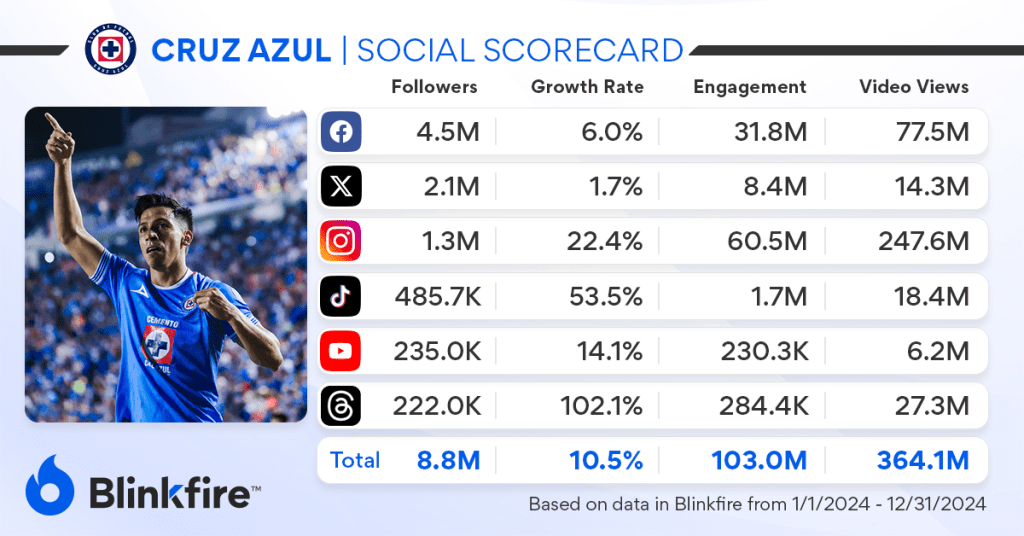
In terms of social media, Cruz Azul ranks third amongst Mexican league teams in followers, total engagement, and total video views. In 2024, the team’s followers grew by over 10%, with Threads seeing the highest percentage growth, increasing by 102%.
In this Customer Spotlight, Rodrigo shares his insights on the evolution of sports sponsorship and the impact of social media and data measurement tools and how it’s impacted the club’s commercial strategies.
You’ve worked in several countries across different continents. What differences have you found in their sponsorship strategies?
I believe that in Europe, the view of sponsorship is more advanced, focusing on conversion and measurable results, while in countries like Uruguay and Mexico, the tradition is still more static, centered on visibility through the shirt and the stadium. However, both markets are evolving towards a more digital model focused on lead conversion and measuring return on investment (ROI).
How does the culture of each country influence sponsorship strategies?
Influence is important because each club’s culture and history are the foundations on which you build the brand strategy to connect with the fan base. Clubs have unique relationship with fans, impacting how sponsorship strategies are designed. At Cruz Azul, we work with values like teamwork, family, and cooperation, which are rooted in the origins of the great company, La Cooperativa La Cruz Azul, and essential to strengthening the connection with followers while aligning with brands that seek to connect on an emotional level.
How has the relationship between clubs and brands evolved in terms of sponsorship?
I believe that the relationship between clubs and brands has evolved due to both the expectations brands have of this relationship and the expectations clubs have of brands. While the ultimate goal is monetization, there are relationships focused more on visibility in certain industries, but with a more solid base of impact. A tool like Blinkfire has helped me show a post to a client and explain what it’s generating, not just in terms of engagement but also economically. Identifying which posts don’t work and where to pivot is incredibly helpful. The more metrics and analysis you have, the more tools you have to negotiate. Engagement numbers and comments alone don’t provide enough data.
Has Blinkfire changed how entities demonstrate their value on social media?
Blinkfire allows clubs to show the direct value of their sponsorships, as well as the value generated indirectly through digital media. This includes media coverage, the impact generated by players, and other aspects that were previously difficult to measure. In the case of high-profile clubs like Cruz Azul or Nacional, the return on investment generated both from digital media outlets and the players’ own posts is significant, and it’s important to highlight this for sponsors.
How do you use Blinkfire?
I use Blinkfire weekly to check key metrics and generate specific reports for sponsors. I have a personalized dashboard to track the metrics I consider most relevant to the current club project, and whenever I speak with sponsors and potential sponsors, I present a report extracted from the platform. It’s also useful for monitoring other clubs’ actions, which has helped identify new assets.
How has sponsorship measurement changed with the use of Blinkfire?
Blinkfire has allowed us to measure ROI in real-time, which is crucial for adjusting campaigns and improving decision-making. Thanks to its ability to provide clear, detailed metrics, we can show brands how their social media assets generate value.
What are the main trends in sports marketing?
Information, metrics, and fan data. Personalization is key; football is all about passion, and the more personalized the message you send to fans, the more passion you generate. That’s a differentiating factor. From my perspective, I try not to get too caught up in implementing new trends but focus on what appeals most to the fan, which is the team’s and players’ performance. From there, find the simplest and most direct way to reach them so they can enjoy what they love. It’s about creating an experience. Personalization on each channel is important so fans feel that the club cares about them, which creates a strong bond.
How do you balance communication with fans and commercial commitments?
By maintaining open communication with brands and explaining the daily dynamics of football, and likewise with players and the entire sports department. That’s key to avoiding an overly commercial focus. At Cruz Azul, we create exclusive information capsules for fans. Through the Sports Intelligence department, we gathered a post-match stat that wasn’t being highlighted but was of interest to fans: the player who won the most one-on-one duels. This stat was shared with the brand CEMIX. In this way, we satisfy the fans’ curiosity while getting brands to connect with the audience in a different, more authentic way, beyond just displaying their logo.
How do you incorporate platforms like TikTok into your sponsorship strategy?
We are gradually understanding that there is a generation we’re not reaching. So, we ask ourselves how we can create communication for a target audience we need to connect with. From there, we integrate it into the communication capsules we create.
What metrics do you consider most relevant for measuring a sponsorship campaign?
It depends on the campaign’s objective and who it was created with. Key metrics may include conversions, lead generation, engagement, or ROI. Depending on the project, there’s a different metric that can be used.
How does the future of social media in sports and sponsorship look?
It’s where you need it to be. Kids are born with a phone in their hand, and it’s getting harder for them to watch a full match. It’s the way to reach new generations. We need to understand how consumption behavior is changing. If we don’t understand how to communicate and how to adapt content, we’ll lose people because they’ll turn to other types of entertainment.
What activation do you remember most for its impact?
A campaign by Club Nacional de Football during the pandemic. Football was suspended just as we were about to play the derby against Club Atlético Peñarol at Nacional’s stadium. That match generates the most revenue for the club. Football returned to the stadium, but without fans, so we didn’t get any income. We launched a campaign where fans could send in their photos, and we printed a banner to put in the stadium. It was a way to say: you’ll be able to be in a classic with all the people you want. After the game, we covered the stadium with that banner, and you could see all the people who had been part of the game. The campaign was magnificent, both emotionally and because we turned a major problem into an opportunity in a creative way, generating revenue.
How can teams leverage their players’ social media influence?
It’s important for players to understand their impact on social media and the value they can generate for their sponsors. In this sense, I believe it’s vital to explain to players the importance of club sponsors, the strategy in place with them, and the impact players can add (or not) through their social media. It’s something essential for their relationship with the club, but also for how they can begin to engage with brands. I’ve had situations at clubs where I’ve shown players a concrete example, like when they post a story about a haircut and “promote” the barber. When they see the return generated by that post, they start to better understand their role on social media.
Elevate your social media game with Blinkfire
Unleash the power of data-driven insights to optimize your social media strategy and grow your audience. With Blinkfire, track performance, value sponsorships, and stay ahead of trends across all platforms.
No Comment