

Integrated Partnership: The Ultimate Story of FC Barcelona and Spotify
Before the 2022 season kicked off, FC Barcelona announced its new main partner: Spotify. At the time, we didn’t realize this would mark a new era — one built on a bold, integrated partnership strategy.
The Swedish media company became the main sponsor of the men’s and women’s first-team kits, as well as the stadium’s naming rights partner.
At first glance, everything seems standard. A brand partners with a team to appear across physical and digital assets. But this partnership stood out for its flexibility and cultural relevance — a new kind of brand activation built to adapt and resonate.
What’s an integrated partnership?
In today’s world, change is constant. Brands must stay agile and on top of fast-moving trends that quickly outpace the ones before.
As a result, the rapid pace has made its way into the world of sports sponsorship. While the foundations remain rooted in proven strategies, new formats are beginning to take hold.
In a landscape where sports sponsorship continues to evolve, cases like FC Barcelona and Spotify illustrate a model that goes beyond visibility, one that prioritizes cultural relevance, flexibility, and multi-platform storytelling.
It adapts to the moment. It’s designed to scale, to resonate, and to align brand and club narratives in ways that feel authentic to fans.
And in the case of FC Barcelona and Spotify, this partnership clearly understood how significant El Clásico — the iconic rivalry with Real Madrid — is in the blaugrana universe.
A clash between two of the most followed clubs on social media in the UEFA Champions League. One of the fiercest rivalries in global sports. A date that always stands out.
That’s why, in 2022, FC Barcelona announced that for that season’s Clásico, global superstar Drake would appear on their jersey — during one of the most high-profile matches for brands, both on TV and across social platforms.
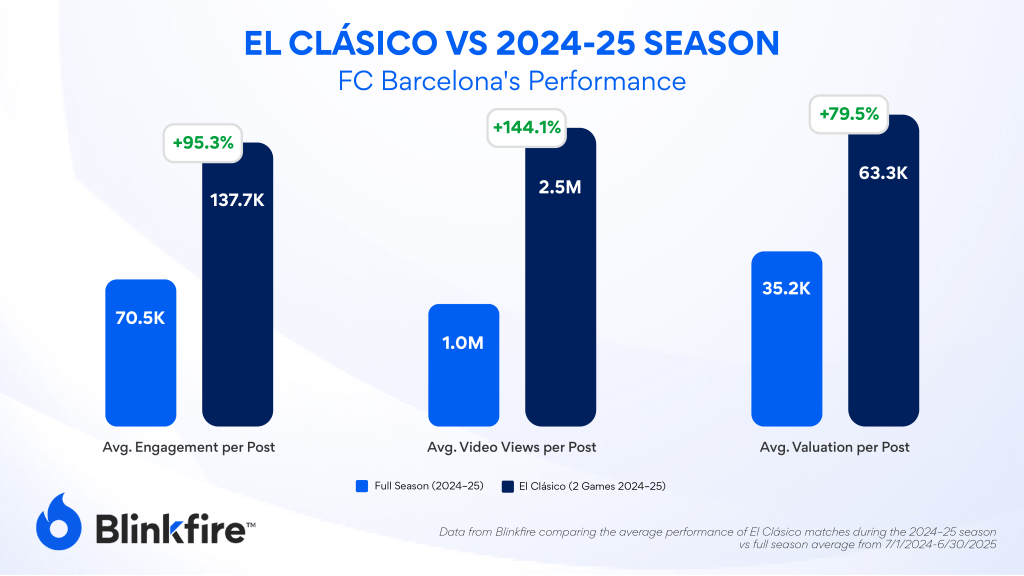
Comparing El Clásico’s performance to season averages offers a valuable perspective — even if the context surrounding this fixture is uniquely powerful.
The rivalry, global anticipation, and cultural spotlight make it an exceptional moment. That’s precisely what makes it so relevant when evaluating the impact of an integrated partnership strategy.
This bold move created a new kind of storytelling ahead of the match. It wasn’t just about the game anymore — it was about leveraging a powerful brand asset like Barça’s kit to amplify an artist like Drake across the sports and entertainment worlds.
A format that repeats — and reinvents itself
- Rosalía: Pop virality meets local identity
Drake paved the way, but the same concept was repeated with another global icon — one with local ties. Rosalía, born in Catalonia, was the most-streamed artist in Barcelona in 2022.
Building on that insight, Motomami would be featured on the kits for not one, but two Clásicos — March 19 for the men’s team and March 25 for the women’s.
This partnership had an emotional core. Rosalía is a lifelong Barça fan and has shown it publicly. In fact, a video of her singing the club’s anthem racked up 77 million views — proof of the viral power when pop culture symbols and sport come together.
- The Rolling Stones: Humor, nostalgia & rock
In October 2023, the legendary British band took center stage on Barça’s jersey. From the stands, they watched the game while fans unveiled a massive banner with their iconic logo.
Barça embraced the moment with creativity, turning its own players into ’80s-style rock icons in a playful tribute to The Rolling Stones. The nostalgic tone and visual humor clicked — one post alone generated 1.9 million engagements and more than 15.4 million impressions, proving once again that integrated partnership can entertain, connect, and perform.
- Karol G: Doble impact & social engagement
The women’s team wore her logo on April 13, 2024, against Villarreal. A week later, the men’s team did the same in El Clásico.
At Blinkfire, we’ve often said: a match no longer lasts just 90 minutes. Social media extends the storytelling — giving clubs a direct line to fans and providing massive visibility for sponsors.
Karol G’s activations made the most of it: her logo appeared on pitch-side signage and in viral content, including a TikTok trend where players revealed they were fans of hers.
- Coldplay: The voice of the fans
On October 26, 2024, the jersey paid tribute to the British band with a logo inspired by their Moon Music album. Spotify, Coldplay, and FC Barcelona donated the proceeds from the collection to UNHCR and the FC Barcelona Foundation.
Beyond the charitable aspect, the partnership also carried emotional weight — Coldplay had been the unofficial soundtrack to the club’s legendary 2009 season.
Before the match, the club revealed the collaboration came from a fan request. In the lead-up, Barça featured Coldplay’s lyrics and visuals like a moon — a subtle nod to the album.
- Travis Scott: When sponsorship becomes a pop culture moment
In May 2025, it was Travis Scott’s turn. The men’s team wore his logo on May 11, and the women’s on May 18. Scott celebrated in the stands as Barça beat Real Madrid — a win that brought them within reach of the LALIGA title, which they clinched in the next match. He also joined the players on the pitch post-game.
But it didn’t stop there. The day before the match, Travis Scott performed live in Barcelona for the first time, turning a jersey sponsorship into a full-on pop culture moment.
Why data matters
Few fixtures generate as much global attention as El Clásico. A sponsorship linked to that moment turns a jersey into a global billboard. It’s a perfect stage for storytelling, visibility, and brand affinity.
But without data, creativity only goes so far. An integrated partnership that doesn’t measure earned media, social reach, or real-world impact will miss the mark. Because it’s not just about being part of one of the biggest sporting events on the planet — it’s about proving what that presence achieved.
When it comes to integrated partnership, creativity and data must go hand in hand.
Running a campaign as powerful as Barça and Spotify’s?
When sponsorship becomes content, you need a tool to activate, group, measure, and prove it. Dynamic campaigns like those featured during El Clásico deserve clear data, real-time tracking, and the right context. Blinkfire Campaigns helps turn every activation into a measurable and presentable story.


No Comment