
K-Pop on social media: Who rules the global fandom
K-Pop doesn’t just compete on social media. It dominates it.
The latest Blinkfire Music Artist Rankings tell the story at a glance: 13 of the top 20 music artists by total social engagement over the last 30 days are K-Pop groups or soloists. Enhypen sits at #1 with over 157 million engagements, Stray Kids follows at #2 with 94 million, and BTS’s Jin rounds out the podium at #3 with nearly 64 million. Other global superstars like Justin Bieber, Olivia Rodrigo and Cardi B are fighting for the spots in between.
What makes K-Pop different isn’t just the size of its fandom. It’s how organized and active they are. Fans stream, share, comment, and translate content in coordinated waves, turning every comeback, tour date, and solo release into a global social moment. For brands and rights holders, that kind of engagement is the closest thing to guaranteed attention in music.
BTS: still the biggest audience in music
No conversation about K-Pop on social media starts anywhere else. BTS has 319.7 million followers across six social channels, led by YouTube (86.5 million), Instagram (82.1 million) and TikTok (81.1 million). That audience earns the group the #3 spot among all music artists on the Blinkfire Index, which scores social activity, influence, content, and growth.
On the engagement leaderboard, BTS ranks #14 with 34.6 million engagements and a $21.1 million valuation with just 10 posts in the last 30 days. Recent content has centered on the BTS WORLD TOUR ‘ARIRANG’, from London pre-order announcements to live cinema viewings from Kaohsiung and Jakarta. Few accounts in any industry can turn a handful of tour updates into that kind of value.
The members: Seven solo bands under one name
Three BTS members out-engage the group’s own channels on the Blinkfire leaderboard. Together, Jin, J-Hope, and V drove roughly 122.8 million engagements and $73.5 million in valuation, about 3.5x what the main BTS accounts generated.
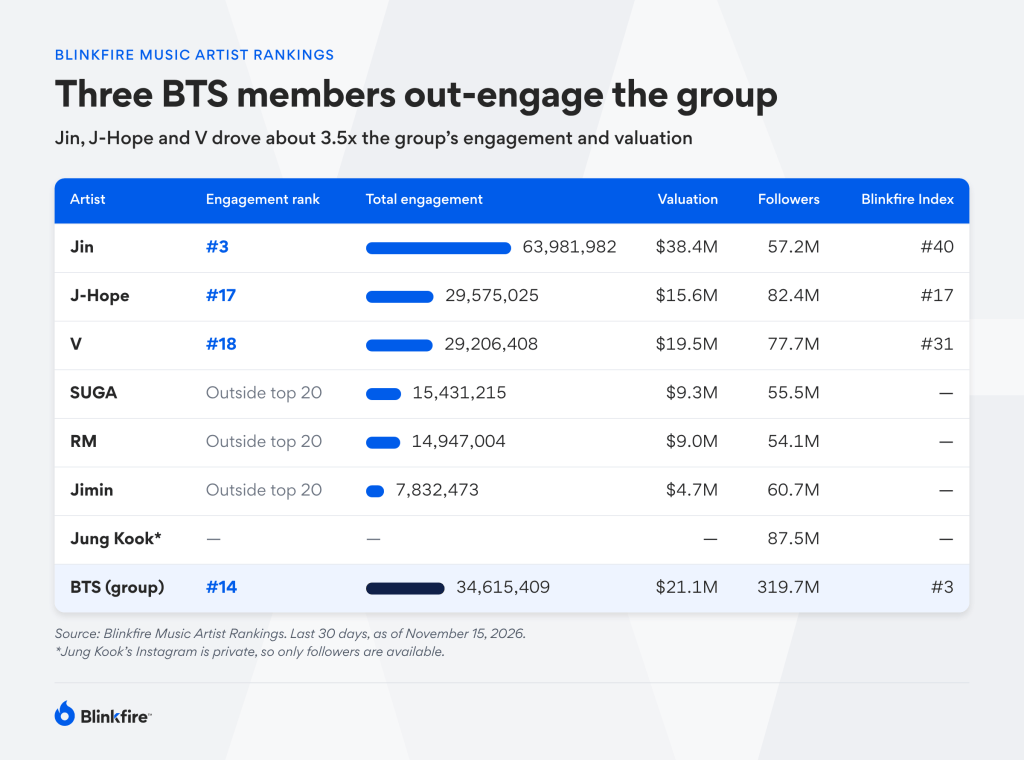
Jin is the standout. His single Instagram account (57.2 million followers) generated nearly double the engagement of the group and the highest valuation of any solo artist in the top 20, on just eight posts in 30 days. Casual, personal content, like an escape-room outing with a fellow idol, is where he’s winning with fans.
J-Hope has the widest solo footprint, with 82.4 million followers across Instagram (57.3 million), TikTok (22.8 million) and YouTube (2.3 million). He’s also the most brand-visible member right now: Blinkfire detected Nike and Louis Vuitton on his posts in the last 30 days, alongside “tour fit” content from the ARIRANG world tour stop in São Paulo.
V owns the single largest personal account in the group, with 77.7 million Instagram followers on Instagram. His recent feed mixes everyday snapshots with luxury fashion content, including a Cartier shoot for Harper’s Bazaar Korea.
RM, SUGA, Jimin, and Jung Kook all command massive personal followings of their own. They sit outside this period’s top 20 by engagement, which makes them the members to watch as new solo releases and tour content roll out. Jimin shows what even a quiet month is worth: his only Instagram post in the last 30 days drew 7.8 million engagements and $4.7 million in valuation.
The next wave of stars is here
BTS opened the door, but a new generation of groups is now leading the engagement charts. Nine more K-Pop acts cracked the top 20 of the Blinkfire Music Artist Rankings:
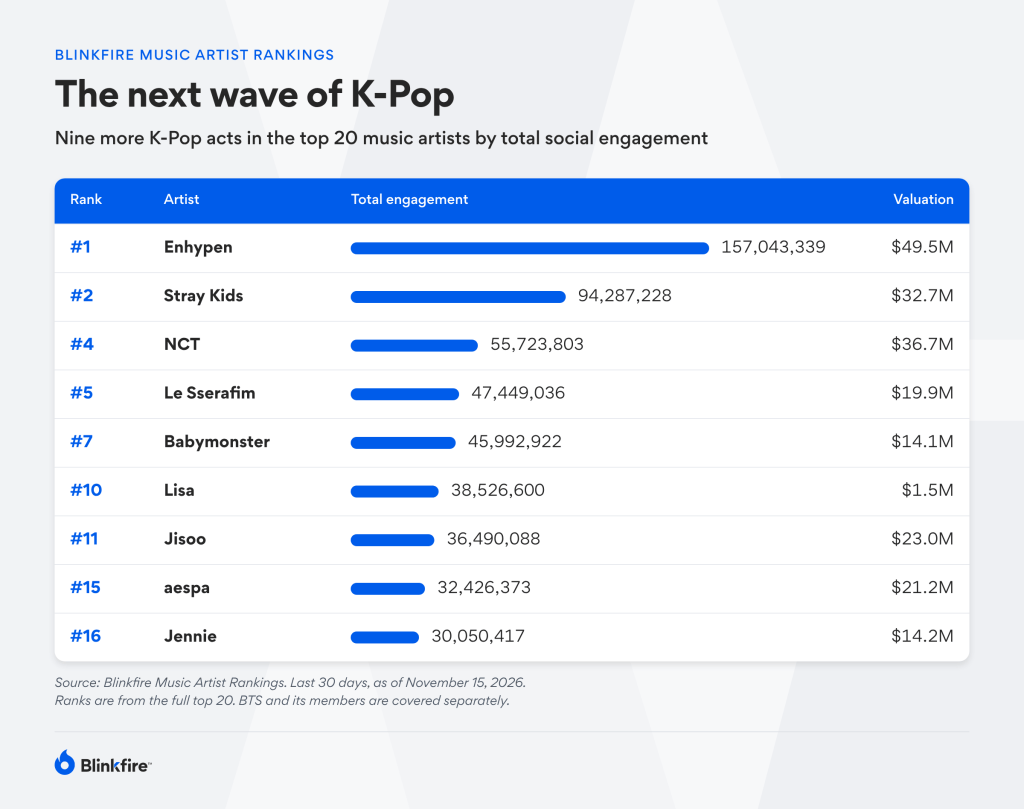
Enhypen is in a league of its own. Its 157 million engagements are 67% higher than #2 Stray Kids and more than three times Justin Bieber’s total at #6. NCT turns its multi-unit structure into a valuation engine, driving $36.7 million in social value, the third-highest figure on the leaderboard.
The girl groups are just as strong. Le Sserafim, Babymonster, and aespa land in the top 15, while BLACKPINK’s Lisa, Jisoo, and Jennie prove the BTS pattern holds across fans. Group members are now solo brands, each with a top-20 audience.
It’s also worth watching Katseye at #8 with 45.3 million engagements. The multi-national group was built on the K-Pop model, and its numbers show how far that playbook now travels.
What K-pop engagement means for brands
For brands, K-Pop’s social footprint is one of the most efficient routes to global attention, but only if partnerships are measured at the right level.
The BTS numbers make the case. A brand deal based on only the group’s accounts would miss most of the value, because individual members generate more engagement than the group. J-Hope’s posts featuring Nike and Louis Vuitton, and V’s Cartier content, are exactly the kind of placements that live on personal channels and need to be tracked there.
The same logic applies across the genre. Fandoms move from group to member to sub-unit, and so does the value. Knowing where engagement actually lands is the difference between guessing at ROI and proving it.
K-Pop isn’t a moment on social media. It’s the main stage. Explore the full, daily-updated rankings at music.blinkfire.com to see where your favorite artists stand.
Track and value your content with Blinkfire
Maximize your brand’s reach with Blinkfire, the all-in-one sponsorship data platform. Organizations world wide leverage our real-time sponsorship insights and valuation reports to accelerate renewals, drive marketing strategies, and optimize content engagement for maximum ROI.
Data from the Blinkfire Music Artist Rankings and artist profiles, as of November 15, 2026. Figures for Lisa and Jung Kook are limited because their Instagram accounts aren’t business or creator accounts.



No Comment